HOW STRATEGIC SEO HELPS SLASH YOUR ECOMMERCE RETURN RATES

I've been buying new curtains lately and I think I've found the most utterly boring household product to buy known to man. I am into double digits with sets of curtains that I have returned - and while standing in the queue to ship them back to the supplier, today's topic came to mind.
With just a few changes, my various trips to the returns depot could have been avoided if the informational and SEO approach ecommerce stores take were different.
What this means for me? I get the curtains I want. What this means for you?
Reduced return rates, higher margins and happier customers.

Here's the 10 second summary for how you can shift your SEO strategy from a traffic first, think later approach to a more nuanced retention strategy...
The silent killer of ecommerce margins are return rates. Return rates of 20% aren't unusual and numbers seem to be trending upwards. [source]
Returns come from a mismatch between what the buyer expects and what the product actually delivers. SEO sits perfectly in the gap between expectation and reality and really help someone before they buy from you
How can we help? By ensuring our keyword and topic strategy is on point, by optimising PDP's to the best of our ability and maximising FAQ's
I've also included a 6 step actionable framework for a SEO Returns Audit
Note: What follows is all working on the basis that your site is in good working order. No orphaned products. No XML Sitemap issues etc. If your store needs a health check then an SEO Audit could be the perfect solution.
Mapping Keyword Intent That Keeps Customers Happy
Let's start by taking a look at your store's core structure. We'll continue with curtains as our example throughout. As normal, we'd expect our search strategy to focus on transactional keywords plus supporting keywords with informational intent.
Transactional keywords are normally picked based on highest volume and lowest competition. But in our race for big numbers we often miss the nuance. So, if you finally start ranking for some big hitting keywords 'curtains', 'curtains + colour' or 'curtains + room type', the traffic flows in but what people are actually looking for can be missed. The result? They order the wrong thing and the returns process repeats itself.
In the world of curtains we can have...
Curtains by type - eyelet, pencil pleat, pinch pleat, hidden tabs, voiles
Curtains by drop - anywhere from roughly 137cm to 229cm
Curtains by width - anywhere from roughly 112cm to 284cm
Curtains by colour - there's at least 19 different colours listed on NEXT's website
Curtains by material - cotton, polyester, chenille, velvet
Curtains by thickness - lined, blackout, thermal, super thermal
Curtains by pattern - striped, herringbone, floral, animal, plain, gingham, jaquard etc
Ready made vs Made to measure
Curtains by room type - namely bedrooms, living rooms and dining rooms
That's quite the list.
(We also have more generic filters based on price, availability, newness, brand and offers)
But every one of these options represents an opportunity to be tapping into more meaningful traffic. Adding more specific PLP's (or PDP's depending on how many SKU's you have) is one of the easiest ways to tap into less competitive seams of traffic by focussing on higher intent, lower competition keywords.

Depending on your product selection there could be vastly more categories on your site than just say, page for eyelet curtains and another one for pencil pleat.

The more specific the search query, the more precise the buyer's expectation. And with a more specific intent. e.g. 'grey thermal eyelet curtains', we can hope that we can keep our margins high as a customer gets what they actually want.
Actions
What high volume keywords could perhaps be avoided that form part of your SEO strategy?
What low competition, high intent keywords can be used to create various PLP's or PDP's?
Informational keywords then play no less a important supporting role. While much of their purpose falls into the role of content marketing to secure additional targeted traffic we want this content on the website to support our buyer's decision making process. With curtains I'd want to ensure we have content answering:
How to measure specific curtain types
How much light can a specific curtain type block?
How much heat can a specific curtain type block?
What types of curtains go best in [insert room type]?
Should curtains touch the floor?
Should curtains be lighter or darker than [insert object]?

Again, like our transactional keywords, we want to be specific here. A great guide to measuring specific curtain types would have stopped me from ordering eyelet curtains that were too short. A detailed guide on how effective thermal curtains are on blocking heat would have meant I didn't end up buying only lined curtains and then regretting it.
Don't make a bunch of mass produced generic articles because someone, somewhere is searching for something related to your topic
Do focus on key customer challenges that align specifically to the level of detail offered by your collection and category pages
Optimising Product Detail Pages (PDPs) for Search and Clarity
Above talks about URL structure. Below focusses on the content of each PDP. Our goal is to keep pages optimised while leaving zero room for customer doubt.
Making a really standout PDP involves -
Filling in the basics - really well. That means tailored, well written, product titles and descriptions as well as filling in all the boxes your system allows. There's a fine John Lewis related curtain example here...

Replacing manufacturer content - Yes, there's certain rules around this and yes, there's only so much time you can spend on any given PDP. But if you're building a page that intends to sell high ticket items in high volumes then it's worth the effort. You really need to convey through images and through copy how a product accurately looks and feels.
(More unique PDP's should also help stores to stand out on Google Shopping, away from the stock photography used by every other supplier.)
Imagery:
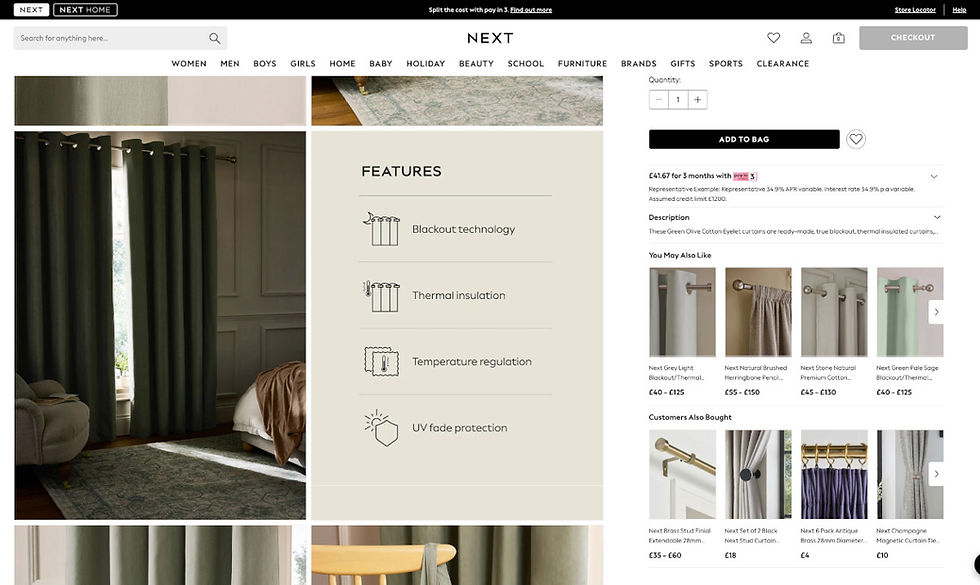
Much like the rules relating to SEO for interior design, the images you upload should be the highest quality but the smallest file size. With curtains, we're looking for how the curtains look in a room from the side and from the front, in the light and in the dark, how they hang, the detailing of the fabric and what a pattern looks like up close. Again, I returned another 2 pairs of curtains because the colour didn't match what they looked like online and how the pattern was far bigger in real life than it originally appeared. Some good examples:

Copy:
We want to follow the same principles as our photography and focus on well crafted, natural language which isn't duplicated elsewhere on the website. It's this kind of thing which increasingly seems to be being picked up by AI engines when people ask more unusual or more detailed questions.
This product description from Joules for their Floral Foulard Line Curtains is a stand-out example. Specifically it mentions the product is neat, traditional, ensures privacy, drapes beautifully. All things people could be legitimately searching for in an ever increasing age of AI search.

No time, energy or headspace for all of this?
Let's get our customers involved with reviews. Assuming they're not going to slate your products leaving a sea of 1* reviews, user generated content is so damn helpful in expanding the content of a page and making the content even more unique. You have 3 main sources.
Submitted reviews
AI summaries aggregating the reviews
Submitted pictures

Naturally, how this is structured will depend on what reviews software you can use and the volume of sales, but any real world feedback only helps to narrow that gap between expectation and reality.
Actions
What areas of content are providing the right level of information across your PDP's?
What images aren't providing the right level of detail across your PDP's?
Is the system and software in place for customers to easily add text and image based reviews?
Upgrading FAQ's for retention and SEO
FAQ sections are the final piece of the puzzle to ensure we're doing everything we can to set expectations with customers.
This can bring together every scrap of knowledge you have at your disposal ready to be presented back to the customer. From customers reviews and reasons for returns data, customer service information, keyword research, chatbot transcripts and general competitive analysis you should have everything you need be able to build a seriously comprehensive stack of clear questions and clearer answers to help people make the right decision.
When it comes to curtains most FAQ's are dedicated pages (as with this example from Dunelm on their made to measure offering). Rarely are they hosted directly on a PDP.
However, a nice and novel exception is what Argos and Habitat have added - offering a on-page Q&A for customers. This is an excellent way of drawing out any missing information not already included as well as adding original unique content to a page. It's a perfect feedback loop.

Bring this all together and you should be building towards a serious reduction in friction that might be preventing people from buying.
Actions
What sources of customer feedback do you have available?
How strong are your existing FAQ sections?
What content needs adding/removing/editing to narrow the gap between expectation and reality?
A SEO Focused Return Audit (An Actionable Framework)
A brief run through for how an SEO consultant would approach this...
Step 1: Cross-reference the highest-return SKUs with their primary organic traffic sources
Step 2: Audit the search queries driving traffic to those pages. Are these misleading?
Step 3: Rework the page copy to explicitly address the top reasons those items are returned
Step 3.1 Rework the page copy to add additional mentions for features likely to be asked in LLMs
Step 4: Rework the image photography (or image functionality) to explicity highlight key features
Step 5: Review the software and systems used to collect and publish reviews
Step 6: Aggregate internal data to ensure FAQ's are speficially answering the most common queries
Drawing things to a close...
Sustainable ecommerce growth isn't just about getting people to the checkout, it's about keeping them happy once their order arrives. SEO has a serious part to play in making that happen.
Reducing return rates requires a sophisticated look at your search data. If you’re ready to audit your organic traffic and align your SEO strategy with actual commercial goals then let's talk.